
Adopting AI in a mid-sized company: why three in four fail
Adopting AI rarely fails on technology. The brake is organisational and cognitive. A working manual for the person in charge.

A few weeks ago, in the office of a leader running a 30 million euro industrial company, I watched an expression cross his face that I know well. A mix of fascination and exhaustion. “Ludovic, everyone talks to me about artificial intelligence. My competitors boast about it, my teams ask for it, my accountant brings it up. And honestly, I have no idea where to take hold of it.” He did not have a technology problem. He had a crowded mind. And the real question, how to adopt AI without getting lost in it, is one a great many leaders are asking.
Everyone talks about it, almost nobody has really deployed it
Look at the figures, because they tell an odd story. In the 82nd half-yearly business survey from Bpifrance Le Lab, published on 13 January 2026 and based on 4,722 responses from small and mid-sized companies, 55 % said they used generative AI at the end of 2025. A year earlier the figure was 31 %, and 15 % in 2023. A fine progression.
Except that the same survey spells out what actually matters: only 17 % use it regularly, and 37 % occasionally. In other words, more than eight companies in ten have no settled use of it. And when you look at what it is used for, the picture holds: generating written content (72 %), searching and analysing information (67 %), translation (34 %). The rest is theatre: three prompts on Monday morning, a rewritten email, a little market watching.
Do you see the gap? The step is not access to the tool: it is free, or near enough. The step is moving from gadget to lever. And that is precisely where more than three companies in four stall.
The brake is neither cost nor technology
The first received idea to dismantle. When a mid-sized company cannot adopt AI, it is almost never a question of budget, the tools have never been more accessible, nor of technical difficulty.
The real brake is organisational. Mick Levy puts it well in his book iA MANiA: the AI rupture is managerial, not technological. The blockage is vague objectives, no integration into processes, no training. The technology is ready. The company is not.
That immaturity has a name: Shadow AI. Your people already use it, many white-collar workers do, but each in their own corner, with no boundaries and no validation. The result: everyone optimises their own small task, and the company gains nothing consolidated. Worse, it exposes its data without knowing.
The real bottleneck is the leader’s mind
I will be direct, because this is the heart of my work. After ten years with chief executives and a path as an engineer, I am convinced of this: a company’s AI transformation plays out first in the head of the person running it.
Three very human mechanisms explain the inertia.
The first is overload. A mid-market leader already decides under pressure, on ten fronts at once. AI turns up as one more subject, badly framed and faintly anxiety-inducing. Faced with uncertainty, our brain does what it does very well: it postpones.
The second is the illusion of control. Handing a task to an agent that never sleeps and never asks for a raise unsettles our relationship with authority and expertise. So we often prefer a process we master, however slow, to a more efficient one we understand poorly. Very human. Also very expensive.
The third is the confusion between activity and value. Many expect a great technological leap, when value actually comes from modest, repeated, almost boring organisational choices. These are often the same cognitive biases that distort our strategic decisions.
Until those three knots are untied, no tool will produce a result. None. That is exactly why I work on both at once, in the same hands: the leader’s mind, and the concrete deployment of AI in the company. One does not work without the other.
How the companies that succeed actually do it
The companies that succeed are not the most technophile. They are the most structured. And three ingredients always recur.
A direction carried by the leader. AI cannot be entirely subcontracted to the IT lead or to a provider. It is for the chief executive to set the intent: which problem we solve, for what gain, within which boundaries. Without that direction, energy scatters in a dozen directions, and that is exactly how Shadow AI is born.
An internal champion. Someone in the building who carries the subject day to day, not necessarily a technician. They bring the teams along and report what people actually do.
An external provider for expertise and speed, in support of that champion. Never instead of them.
And a sequence in three stages, always in the same order: familiarise, experiment, deploy. Dispel the myths and train the leadership team first. Then test, on a narrow, measurable perimeter. Then generalise. You never industrialise what you have not first tamed.
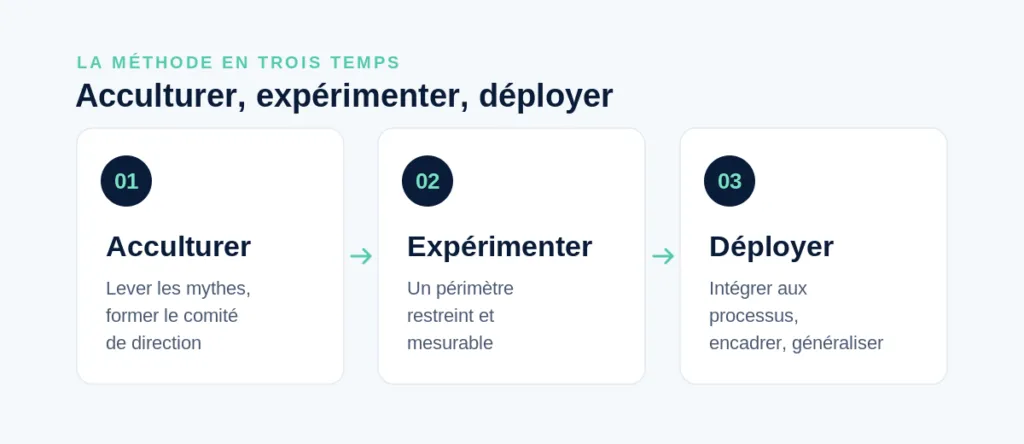
The three-stage method for adopting AI in a mid-sized company.
Set the boundaries before you accelerate
Adopting AI without setting any governance does not save time: it moves the risk. Generative AI has a flaw your teams underestimate: it produces plausible answers, not necessarily accurate ones. A wrong analysis slipped into a file, a poorly protected client record, a contract reviewed by an unsupervised model, and the productivity gain is paid for in legal or reputational risk.
So the boundaries are not administrative drudgery to be dealt with later. They are part of the deployment. Three questions need a written answer before you generalise:
- Which uses are permitted, and which are forbidden? For instance: never sensitive client data in a public tool.
- Who approves an AI output before it leaves the company?
- Who checks the reliability of the data feeding your models?
These boundaries do not slow the transformation. They make it possible. They turn Shadow AI, endured, into use that is owned, and they reassure teams, who move from clandestine improvisation to a legitimate practice backed by the top of the company.
Start with one single use case
The classic mistake is wanting to “do AI” everywhere, immediately. The right approach is the exact opposite: choose one single use case, high return and low risk, and carry it through to the end. It is as true for AI as it is for growth: concentration beats dispersion.
The business press is starting to document these quiet successes: industrial companies that sharply shorten the delay between quote and invoice using agents, without cutting a single job, because the teams freed up are redeployed onto work that genuinely carries value. That is the right story about AI in a mid-sized company. You automate to extend, not to make people redundant.
One successful use case is worth a thousand slide decks. It creates internal proof, it reassures, and it gives the leader what I would call, in the neurological sense, the confidence to go further.
A working manual, from Monday
- Pick a pain, not a technology. Start from a concrete irritant in your company, a delay or a repetitive task, not from a fashionable tool.
- Name your internal champion. One person, a name, dedicated time.
- Set the boundaries before deploying. Write down what is permitted, who approves, who checks the data.
- Aim at one measurable use case. A gain in figures, a deadline.
- And work on your own ability to let go. That is often the real job, and the most profitable.
Adopting AI is not an IT project. It is a leadership project, which commits the organisation and, upstream of it, the mind of the person running it. Costs have fallen, the technology is mature. What separates the 17 % with regular use from everyone else is the clarity of the direction, the quality of the familiarisation, and your ability to delegate without letting go.
You can place your company on these five points in three minutes: the AI readiness check gives you your score, your profile and the axis to start with.
If you want to identify the first high-return AI use case in your company, and lift whatever in your own way of working is slowing the shift, that is precisely where an engagement starts.
Frequently asked questions
Do you need a large budget to adopt AI in a mid-sized company?
No. The tools have never been more accessible, and the first use case is usually handled with standard building blocks. The real cost is leadership time and training, not licences.
Who should carry the AI subject inside the company?
The leader sets the intent: which problem is being solved, for what gain, within which boundaries. An internal champion carries it day to day, without needing to be technical. The external provider brings expertise and speed, in support, never instead.
How do you set boundaries for AI without slowing the teams down?
Three questions need a written answer: which uses are permitted and which are forbidden, who approves an output before it leaves the company, and who checks the reliability of the data. These boundaries do not slow the transformation down, they make it possible.
Does AI cut jobs in mid-sized companies?
The documented cases run the other way: teams freed from repetitive tasks are redeployed onto work that carries value. You automate to extend, not to make people redundant.